How battles work: formations, tactics and morale
Most battles are not won by the bigger army but by the army that breaks last. This guide covers the choices you make before the fight, the orders you give during it, and the rules for damage and morale that decide it.
Before the fight: formation, tactic, commander
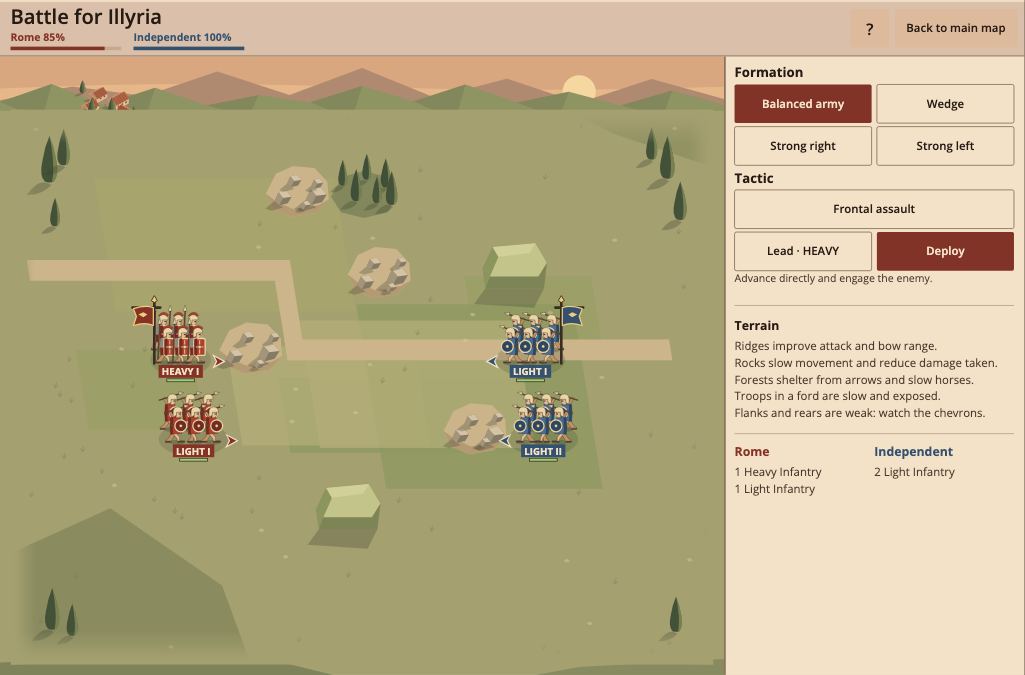
When you attack, or command the defence of a province, the battle opens paused. You choose three things:
- A formation: where your cohorts stand at the start.
- A tactic: what they do in the opening moments, before you take over.
- The commander’s cohort: the cohort your commander fights with. Orders reach only so far from him, and losing him costs morale, so put him with a sturdy cohort, not at the front of a charge.
Each formation offers its own tactics:
| Formation | Tactics |
|---|---|
| Balanced army | Frontal assault, Scipio’s defense, Drive a wedge, Outflank, Stand fast |
| Wedge | Frontal assault, Drive a wedge, Form a line, Cannae tactic, Stand fast |
| Strong right, Strong left | Frontal assault, Sweep right, Sweep left, Mass troops, Stand fast |
| Tactic | What the army does |
|---|---|
| Frontal assault | Advances directly and engages the enemy. |
| Stand fast | Holds position and attacks enemies within reach. |
| Drive a wedge | Pushes the centre forward ahead of the wings. |
| Outflank | Sends melee cohorts wide before turning on the enemy. |
| Scipio’s defense | Holds the front while the rear shifts to the right. |
| Form a line | Brings cohorts into an even front before advancing. |
| Cannae tactic | Holds the centre back while the wings advance. |
| Sweep right / Sweep left | Shifts the army toward that flank, then advances. |
| Mass troops | Brings the army together and holds the centre. |
Your troops and what beats what
| Troop type | Strength | Attack | Moves | Strong against | Weak against |
|---|---|---|---|---|---|
| Heavy infantry | 20 | 5 | 2 | Cavalry | Archers |
| Light infantry | 12 | 5 | 3 | — | — |
| Cavalry | 15 | 8 | 5 | Archers | Heavy infantry |
| Archers (shoot from afar) | 8 | 6 | 2 | Heavy infantry | Cavalry |
A cohort deals 50% more damage to a type it is strong against. The rule of thumb: cavalry hunts archers, heavy infantry stops cavalry, archers wear down heavy infantry from a distance.
Giving orders
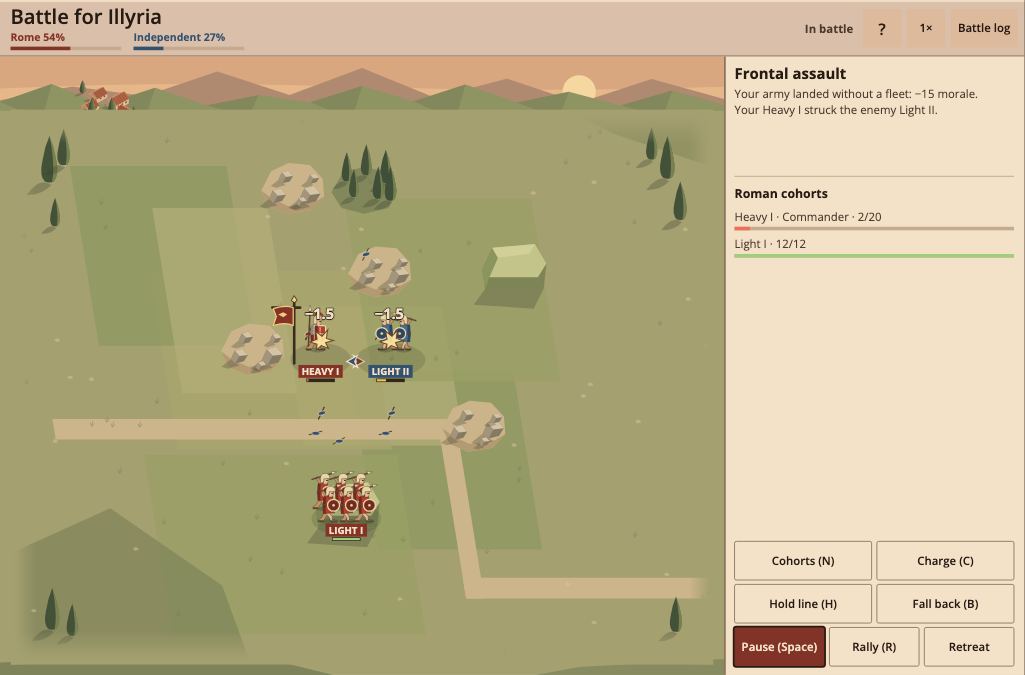
Once deployed, cohorts fight on their own. Press Pause or Space at any moment to give orders; they are carried out when you Resume.
- One cohort: select it, then select ground to march to or an enemy to attack.
- Command range: orders reach 3 tiles from your commander. Farther off, only Melee works: it lets the cohort fight on its own.
- The whole army: with no cohort selected, Charge (C), Hold line (H) and Fall back (B) command every cohort at once, as long as the commander lives.
- Speed: the speed button (S) switches between half, normal and double speed.
- Battle log (L) lists every blow with the modifiers behind it, so you can see why a fight went as it did.
Flanks, rears and charges
Every cohort faces the way the chevron at its feet points. A blow from the side or from behind does more damage and shakes the army that takes it:
| Blow | Extra damage |
|---|---|
| To the flank | +30% |
| To the rear | +60% |
| Cavalry charging into contact | +50% |
| Light infantry charging into contact | +15% |
Cavalry is at its best in that first charge. Once locked in melee it fights 20% worse, so pull it out and charge again rather than leaving it to grind.
Ground
The battlefield is not flat. The panel at deployment says what each kind of ground does:
- High ground adds 25% to attacks made from it, and 1 tile to an archer’s range.
- Rocks slow movement and cut the damage a cohort standing among them takes by 25%.
- Forest stops 50% of arrows, and horses fight 30% worse among trees.
- A ford leaves troops exposed: they take 25% more damage.
Morale, and why armies break
Each side’s morale is shown at the top of the screen. An army fights until its morale falls to 25 or below; then it breaks and runs, and the battle is over. That is how most battles end, long before the last cohort falls. Morale falls:
- as the army loses strength in wounds and fallen cohorts;
- by 25 at once if the commander’s cohort is destroyed;
- with every blow taken in the flank or the rear, and with every cavalry charge received;
- by 15 before the battle starts, for an army that crossed the sea without a fleet.
Rally (R) raises your army’s morale by 18, once per battle. It works only while the commander lives and another cohort stands within 2 tiles of him. Keep it for the moment the line wavers, not the first blow. A general’s experience also adds morale (5 for each level), and a Stalwart general starts every battle with 10 more.
Retreat and defence
An attacking army may Retreat: the battle ends and the survivors go home. A garrison defending its own province cannot; it fights to the end. When a rival attacks a defended Roman province, you choose to command the defence yourself or let it resolve on its own.
A battle in progress is saved with the campaign. Close the page in the middle of one and it comes back paused, with the same armies and orders.
Try a single battle from the title screen: no campaign needed.
Play now